
Moscow speaks: how Stalin performed at the Mayakovskaya metro station

At the moment when German troops were standing at the gates of Moscow, on November 6, 1941, at the Mayakovskaya metro station, Joseph Stalin said from the podium the famous: "Our cause is just! Victory will be ours!" And on December 6, Vladimir Bortko's film "Stalin" will be released on REN TV, which will once again draw attention to one of the most controversial figures in Russian history. But the memory of the leader is preserved not only by cinema: in the Moscow metro, traces of the Stalin era can still be found in mosaics, architecture and historical details of stations. On the 85th anniversary of the historic meeting of the State Defense Committee, Izvestia went underground to restore the events of the significant day together with the guide.
The Underground Chronicle of the Epoch
The Moscow Metro is not just a transport system. During the Great Patriotic War, it became a reliable bomb shelter for the townspeople, and today it has turned into a real museum of the country's history, where full-fledged tours are conducted.
One of them, "The War and Peace of the Moscow Metro," is dedicated to the footsteps of Joseph Stalin in the Moscow subway. We met with the guide Yulia Kosova on the Belorusskaya Ring Line. She began her story by debunking a well-known myth.

According to a popular legend, the ring line appeared thanks to a cup of coffee. Allegedly, Stalin was brought a metro development plan, and, examining it, the leader put a cup on paper. There was a brown circle in the drawing, and that's how the idea of the ring came about.
"That's not true. The ring line was planned back in the 19th century, when they were just thinking about building the Moscow metro. And the story of the cup of coffee appeared much later — in the 1990s, when this story was told to foreigners. According to one version, the brown color of the line was chosen for quite practical reasons: it was easiest to get it by mixing several basic colors," explains the guide.
Over the years, Stalin's image in the Moscow subway was either immortalized in mosaics, sculptures and slogans, or got rid of any reminders of him. Traces of these changes can still be found at the stations. However, one of them occupies a special place in history — "Mayakovskaya".

Meeting underground
In the USSR, November 7 was one of the main public holidays — the Day of the Great October Socialist Revolution. Although the most powerful air defense system in world history was created around Moscow, German planes nevertheless broke through to the city and sometimes inflicted very sensitive strikes. It was impossible to put the country's leadership at risk.
—Mayakovskaya station was chosen for the meeting of the country's top officials as the most spacious, deepest (34 m deep), and also as one of the most beautiful in the Moscow Metro," military historian Dmitry Boltenkov told Izvestia.
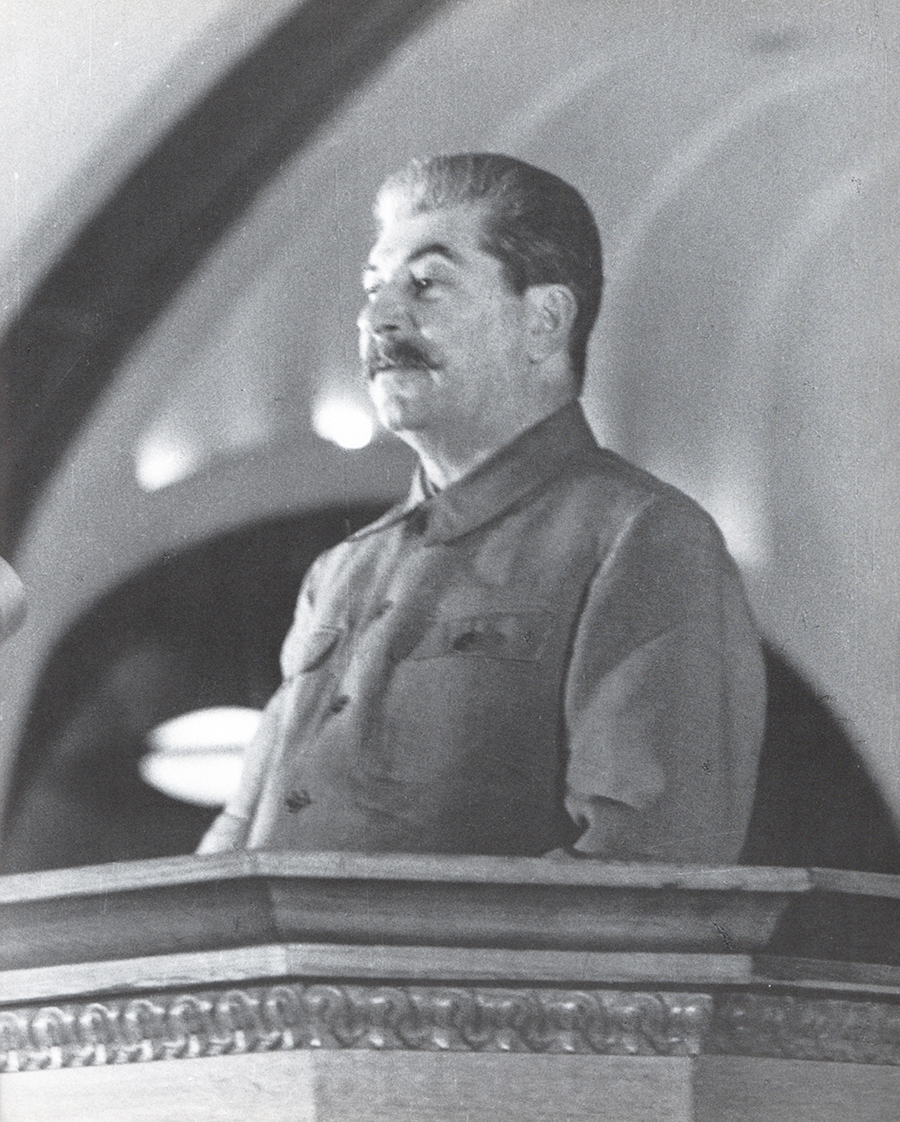
Formally, it was not a closed meeting of the State Defense Committee (GKO), but a solemn meeting of the Moscow Council of Workers' Deputies together with party and public organizations. However, everyone understood that with the enemy approaching the capital, the future of the country was being decided here.
On the morning of November 6, Mayakovskaya station was not opened to passengers. Trains passed by the platform without stopping while the staff was preparing it for the reception of especially important guests. Chairs and a special bedside table were brought from the Bolshoi Theatre, and radio broadcasting equipment was installed. At five o'clock in the evening, the contact rail was disconnected.
The invitees were informed about the venue of the meeting literally at the last moment. The only way to get to the platform was on foot, using the disabled tracks. According to the guide, about two thousand people gathered at Mayakovskaya. Beer was poured for the guests and red fish sandwiches were served.
Today, not much is known about how the meeting was held. Almost no everyday photographs have been preserved. Since the beginning of the war, radios and cameras were seized from the population, fearing that spies could use them. Therefore, the pictures of the pre—war "Mayakovskaya" are mostly the work of foreign photographers or official government photographs.

The meeting began at seven o'clock in the evening. Stalin made a speech, summed up the first months of the war and acknowledged that the country had lost vast western territories, but nevertheless resisted. The main message of the speech was the confidence of the USSR leadership in the future victory.
— This confidence has been transmitted to both the peoples and the army, as well as to the leadership of other countries. The leaders of the USA and England, to put it mildly, did not believe that the USSR would stand," Dmitry Boltenkov noted.
At the end of his speech, Stalin uttered the phrase: "Our cause is just — victory will be ours!" It has become the country's motto, an expression of its desire for victory. And although Vyacheslav Molotov first uttered these words on June 22, they became fixed in the public consciousness precisely as Stalinist.

Deineka's Riddles and Lily Brick's Letter
Later, Stalin's speech at Mayakovskaya was captured by several artists. The most famous painting belongs to Irakli Toidze. Alexander Deineka also portrayed this event. However, unlike Toidze's more accurate work, Deineka was quite free with historical details. In his painting, the audience is not sitting, but standing, although the newsreel shows the opposite. Stalin himself is depicted in an overcoat and a headdress, as he performed the next day from Lenin's Mausoleum. And the mosaic with the red flag on the ceiling is completely out of place.

At the same time, it was Deineka who created the sketches for 35 panels on Mayakovskaya, and mosaicist Vladimir Frolov typed them. Only 34 images have survived to this day. The last mosaic was removed during the installation of hermetic closures, special massive structures that were used to equip deep—laying stations for protection in emergency situations.
The contents of the lost work, however, are known. According to the artist's idea, the composition began and ended with the image of the flag. Why the author, who created the sketches of the panels himself, swapped the images of the mosaics in his own painting remains a mystery.
There is another historical detail. For a long time, the exit from the Mayakovskaya station was only on one side. Therefore, it was believed that Stalin was delivering a speech at the end of the platform. In the photographs and paintings, a wall is visible behind his back. However, a few years ago, a reference to escalators behind the leader was found in the memoirs of eyewitnesses.
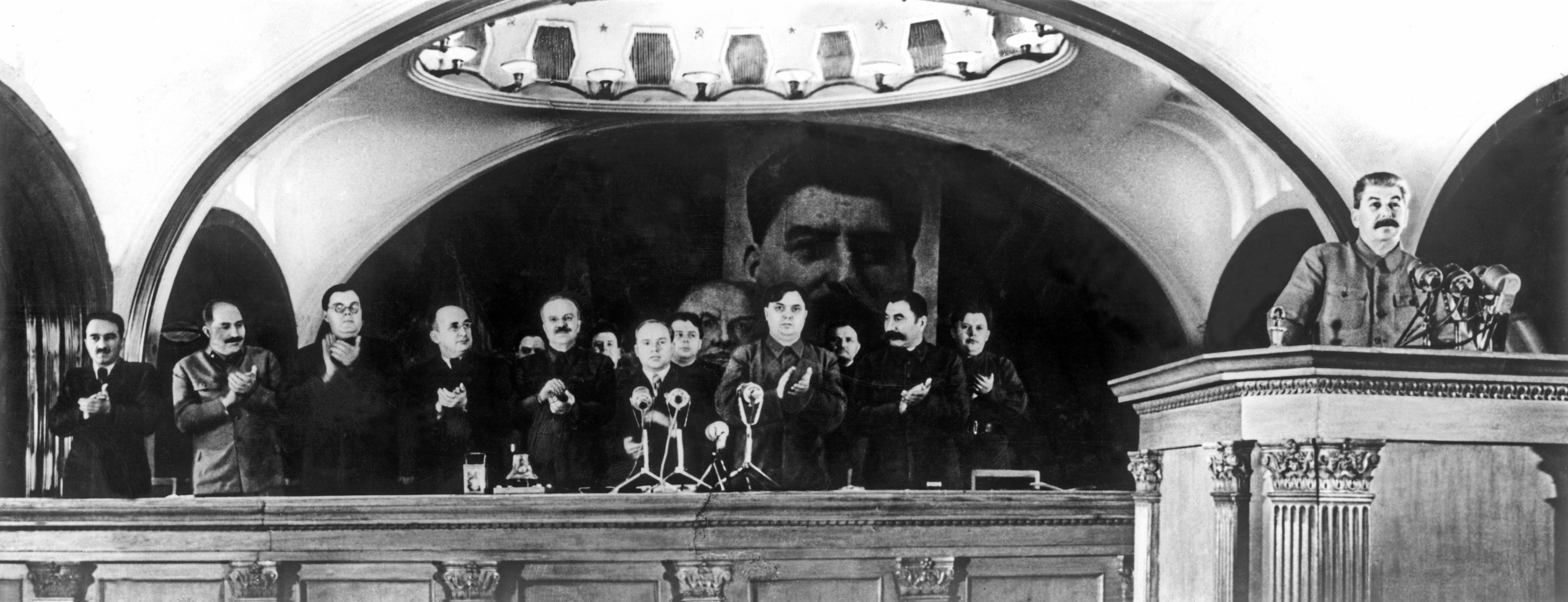
This is understandable. In the event of an attack by Stalin, it was necessary to evacuate urgently, and not leave underground in the depths of the station. Therefore, as the researchers suggest, a fictitious wall was built for the meeting.
Finally, Stalin had a hand in naming the station. Initially, it was planned to name it "Triumfalnaya" — in honor of the square, which was located at the top. However, the name has changed thanks to Lila Brick. She addressed Stalin with a letter in which she recalled that only five or six years had passed since the death of Vladimir Mayakovsky, and the memory of the poet had already begun to be forgotten. Brik emphasized his special role in revolutionary poetry and considered it unfair to exclude Mayakovsky's name from the life of the country. Stalin's reaction was immediate. As a result, the square was renamed in honor of the poet, and then the station received a new name.

The Soviet poet Vladimir Vladimirovich Mayakovsky and Lilya Yurievna Brik
Today it is difficult to imagine that the fate of the capital and the whole country was once decided under its elegant arches. They talked about resistance, hope, and historical memory. And a few hours after the historic meeting, Moscow was preparing for a parade that was supposed to show the whole world that the city was not broken.
Переведено сервисом «Яндекс Переводчик»
