Pilot weather: New technology will provide UAV control without satellite signal
- Статьи
- Science and technology
- Pilot weather: New technology will provide UAV control without satellite signal


Russia has developed a technology for transmitting video and control commands for drones and robots in conditions of unstable mobile or satellite communications. The device weighs only 50 g. The system automatically adapts the compression ratio of the video stream to the available bandwidth of the channel, and part of the data processing is performed directly on board the device. Tests have shown that the technology allows you to transmit images and control commands even at very low connection speeds. The solution can provide drone control without specialized satellite communication systems such as Starlink and Iridium.
The video adjusts to the channel speed
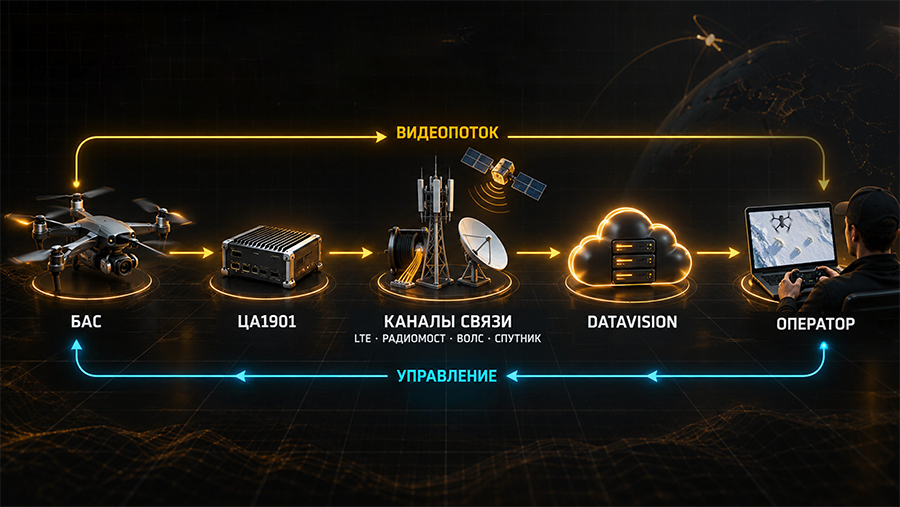
Russian engineers have developed a technology for controlling UAVs in low-connectivity conditions. DataVision's software can work as part of a separate PAK module (software hardware complex) weighing about 50 g, which is installed on a drone or robot. The task of the system is not to amplify the radio signal, but to adapt the amount of transmitted data to the capabilities of the communication channel.
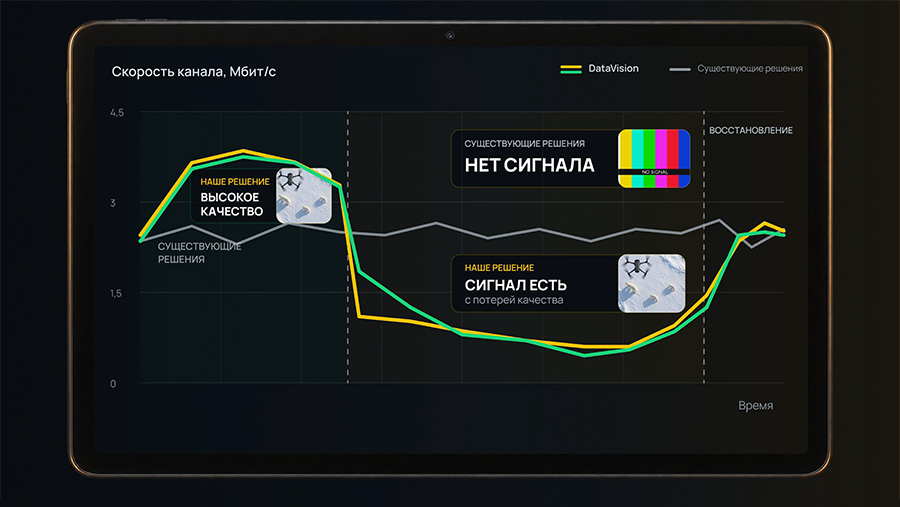
If the connection is unstable, the normal video stream may be delayed, lose quality, or be completely interrupted. The development automatically changes the video compression settings depending on the available data transfer rate. At the same time, the neural network can recognize objects and key events directly on board the device, so it is not necessary to transmit the entire source video stream to the operator.
During the tests, the technology provided video transmission at a connection speed of 25-70 Kbit/s and allowed remote control of devices thousands of kilometers away.
The development is used not only in unmanned systems. Over the past six months, the creators have conducted a series of pilot tests in various fields.
"If we explain the principle of operation, the PAK module selects and compresses frames based on the bandwidth of the channel, while maintaining the ability to control the device and monitor objects," explained project manager Alexander Artyukhov.
According to the developers, the operator can be located at a considerable distance from the device, and the system will continue to transmit data and commands even with limited channel capacity. The authors of the technology have registered more than ten patents.
Less reliance on satellite systems
According to Artyom Bogatyrev, market expert at NTI Aeronet, video transmission at speeds of 25-70 Kbit/s is a significant result for such systems. Another advantage of the development, he called the processing of some information directly on board the drone: this allows you not to overload the channel with the transmission of the entire video stream.

"The mass of the device also suggests that it can be installed on small drones," he said.
According to him, the next stage should be to test the development in various conditions.: with strong radio interference, low temperatures and on different types of drones.
One of the potential advantages of the technology for the drone industry may be a reduction in dependence on specialized satellite communication channels. Satellite access systems such as Starlink can be used to control devices over long distances, but their use depends on the availability of appropriate infrastructure and equipment. The development makes it possible to use the already available communication channel more efficiently, which helps to solve this problem, explained information technology specialist Sergey Pomortsev.
— The main advantage of the solution is to increase operator safety: it helps to control the drone from a distance even with weak communication. At the same time, it technically allows you to control the control of UAVs without depending on international solutions such as Starlink or Iridium," the expert noted.
Unstable communication remains one of the common problems in the operation of drones, said Mikhail Novoselov, Head of the Department of Theory and Methodology of Computer Sports, Chess and Digital Technologies at the Russian University of Sports GTSOLIFK, co-author of the FPV drone operator training program.
— Communication instability is common in the field of UAS and UAVs, however, when performing special tasks, this factor becomes critical. Research and development in this area is extremely important, since such technologies can be used to solve strategic tasks," the expert said.
The developers are betting not on increasing the signal strength, but on more efficient use of the available communication channel. This allows you to transfer the most important data to the operator even at low connection speeds and potentially expands the control capabilities of drones in conditions where conventional communication channels are intermittent. According to the experts interviewed, the practical significance of this approach may be higher than it seems at first glance.
Переведено сервисом «Яндекс Переводчик»
