- Статьи
- Culture
- From the world to the masterpiece: the Ludwig collection from the collection of the Russian Museum arrived in Moscow

From the world to the masterpiece: the Ludwig collection from the collection of the Russian Museum arrived in Moscow

An exhibition of 20th-century masterpieces donated by German collectors to the State Russian Museum has opened in Moscow in the ZILART space. The exhibition brought together more than 100 works by recognized masters of world art: Pablo Picasso, Andy Warhol, Ilya Kabakov, Eric Bulatov and many others. Some works are being exhibited for the first time. Izvestia was among the first to get acquainted with the Peter and Irene Ludwig collection, which collectors spent half a century forming.
The Ludwig Legacy
The route opens with a portrait of Peter Ludwig, a German industrialist, philanthropist and art collector. This is the work of Andy Warhol, the leader of pop art. The American artist processed the photograph in his signature technique: he transferred a heavily enlarged photograph to a primed tinted canvas using the silkscreen printing method. It is symbolic that this particular portrait greets the guests of the exhibition at the Moscow Zilart as a personal invitation to get acquainted with the collection that Peter and Irene Ludwig have been building for almost half a century and whose gift to the Russian Museum opened the Russian Federation access to the masterpieces of world art of the XX century. The exhibition features more than 100 works donated by the couple in 1994.

Portrait of Peter Ludwig. Andy Warhol
Since 1995, the collection has been exhibited in the halls of the Marble Palace (a branch of the State Russian Museum in St. Petersburg) in the format of a permanent exhibition, the composition of which has changed periodically. The entire collection is presented at Zilart for the first time. Some of the works have not been exhibited before.

Hubertus Gibet "Illusion and Shock"
— We changed the expositions in the Marble Palace. Here we showed the entire collection: one hall is dedicated to myths, the other to realism, and so on," explains the curator of the exhibition, Margarita Kostrits, in an interview with Izvestia. — This is due to a simple matter: we did not have such an opportunity there, because the space is limited, and we showed the works in parts by topic. It happened that a certain work was not exhibited for a long time — it appeared briefly, then left again.

Marika Myakeli "Under the arches of the water"
Among the rare works is a large—format canvas by the German artist Hubertus Gibe "Illusion and Shock". The central figure (an image referring to Christ) is defeated by the onslaught of an impersonal crowd. Gibet worked on the painting, reflecting on the fate of the world on the verge of disaster, and dedicated it to the memory of the philosopher and cultural theorist Walter Benjamin. There is also a painting by Marika Myakel "Under the arches of the water". In it, the artist creates the effect of looking from the depths: the viewer seems to be looking up through the water column at the light breaking through. Oil and acrylic technique allows you to achieve a complex texture, and gold and silver accents add inner tension to the composition.

From Picasso to Eric Bulatov
The Ludwig Collection is not just a collection of works, but a well—thought-out system of views on the evolution of art: in it, different directions enter into a lively dialogue. Peter and Irene were not afraid to include unexpected names of artists from the USSR, Eastern Europe, Cuba and Mexico, who were poorly represented in the Western market at that time. Their collection thereby expanded the usual boundaries of art discourse.
The architecture of the exhibition also takes up this idea: the space is built not as a linear narrative by epoch or country, but as a series of semantic echoes. The works are combined into thematic blocks, where the proximity of canvases gives rise to new shades of reading and makes you feel how differently the masters of the same era answered the same questions.

One of the blocks is hyperrealism, represented by the works of Ralph Goings, Robert Bechtle, Lowell Nesbitt and Klaus Schmetz. They are united by extreme, realistic precision. The other pole is the German neo—expressionism of Anselm Kiefer, Georg Baselitz, Joerg Immendorf and Markus Lupertz, where paintings are characterized by sharp color contrasts, distorted forms and an appeal to myth.

The contrast of directions is emphasized by another painting — "Big Heads" by Pablo Picasso, painted four years before the artist's death. This late work confirms that even in his nineties, the Spanish genius avoided creative stagnation. In it, each of the two heads is simultaneously shown both full—face and in profile, a technique that refers to the Cubist search for the master. Rigid broken lines and bright spots turn the image into a visual puzzle.

— The world's Western art of the second half of the 20th century was almost never represented in Russian museums until the moment when the world's most famous collectors Peter and Irene Ludwig donated their collection of masterpieces to the Russian Museum. And it is unique in that it presents absolutely all the most important trends and phenomena in the world of fine art of the XX century. The value of this collection must be understood — it is immeasurable," said Alla Manilova, General Director of the State Russian Museum in St. Petersburg.
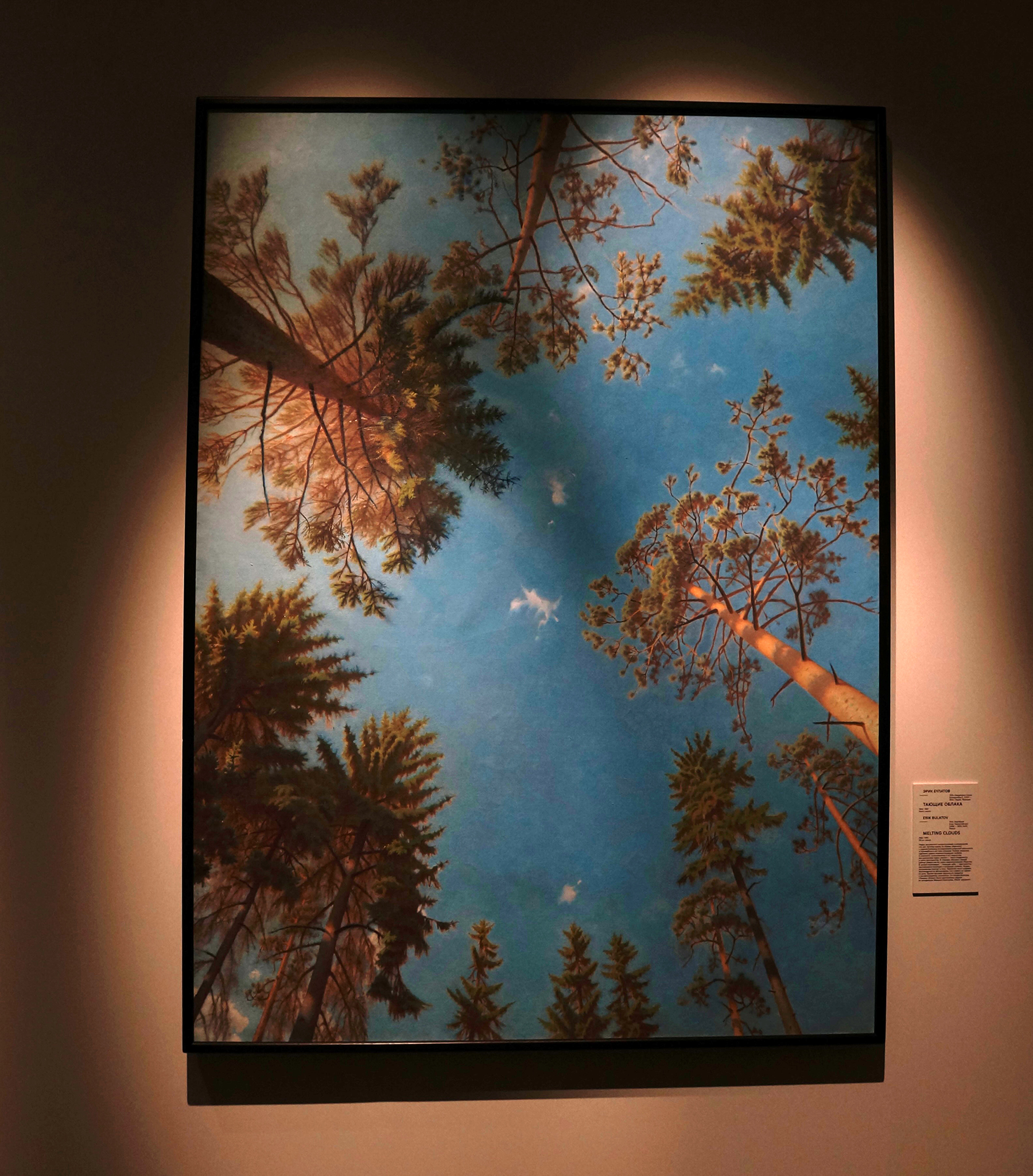
Among the works acquired by the Ludwigs are paintings by Soviet artists. Ilya Kabakov in The Garden confronts painting with text, turning the viewer into a co-author of meaning. In "Melting Clouds," Eric Bulatov works with an optical illusion — a forest landscape seen from below through a wide-angle lens becomes a metaphor for a passing era. Vladimir Yankilevsky's "Triptych No. 14. Self-Portrait (In Memory of his Father)" combines painting with sculpture, on the one hand, exploring the alienation of a person in a megalopolis, on the other — creating a metaphor for the connection between father and son. In his triptych, Igor Makarevich portrays colleagues — Chuikov, Kabakov, Bulatov — by placing images of masters of Moscow conceptualism on the back walls of real Soviet cabinets.
It will be possible to get acquainted with the rich collection of Ludwigs in ZILART until next year: the exhibition will be open to the general public until February 7.
Переведено сервисом «Яндекс Переводчик»
