
Paper games: every third purchase in Russia was paid for in cash

Cash, which had been steadily losing to cards and smartphones until recently, began to regain lost positions — this spring, every third purchase in Russia was paid for with paper money, the OFD Platform told Izvestia. Compared to last year, their share immediately increased by 5 percentage points to 30.2%. The reasons are interruptions with the mobile Internet, the growth of the shadow sector and the desire of businesses to save on acquiring. Russians themselves have also played a role, as they have become more likely to keep their savings "under the mattress." Where bills turned out to be more necessary than cards and what can bring buyers back to non—cash payments is in the Izvestia article.
Why are people switching to paper money
Russians have become more likely to pay in cash after 10 years of growth in cashless payments. If at the beginning of 2025, cards and other electronic payment methods accounted for 75% of purchases, now this trend has begun to unfold. In April-May 2026, the share of cash payments increased to 30.2% against 25% a year earlier, Dmitry Batyushenkov, CEO of the OFD Platform, told Izvestia.

At the same time, the amount of "live" money in the economy is also growing. According to the Central Bank, in April, the volume of cash reached 20 trillion, an increase of 14% over the year. In addition, by the end of 2025, Russians had about 3.3 trillion rubles in their hands.
Moreover, this year the volume of cash began to grow especially rapidly. Since January, it has grown by 1.2 trillion in circulation, which is already more than in the whole of 2025, when the increase amounted to 0.8 trillion, said Dmitry Gritskevich, head of Banking and Financial Market Analysis at PSB. However, not all of this money is used for purchases. Citizens and companies simply keep part of the funds as savings.
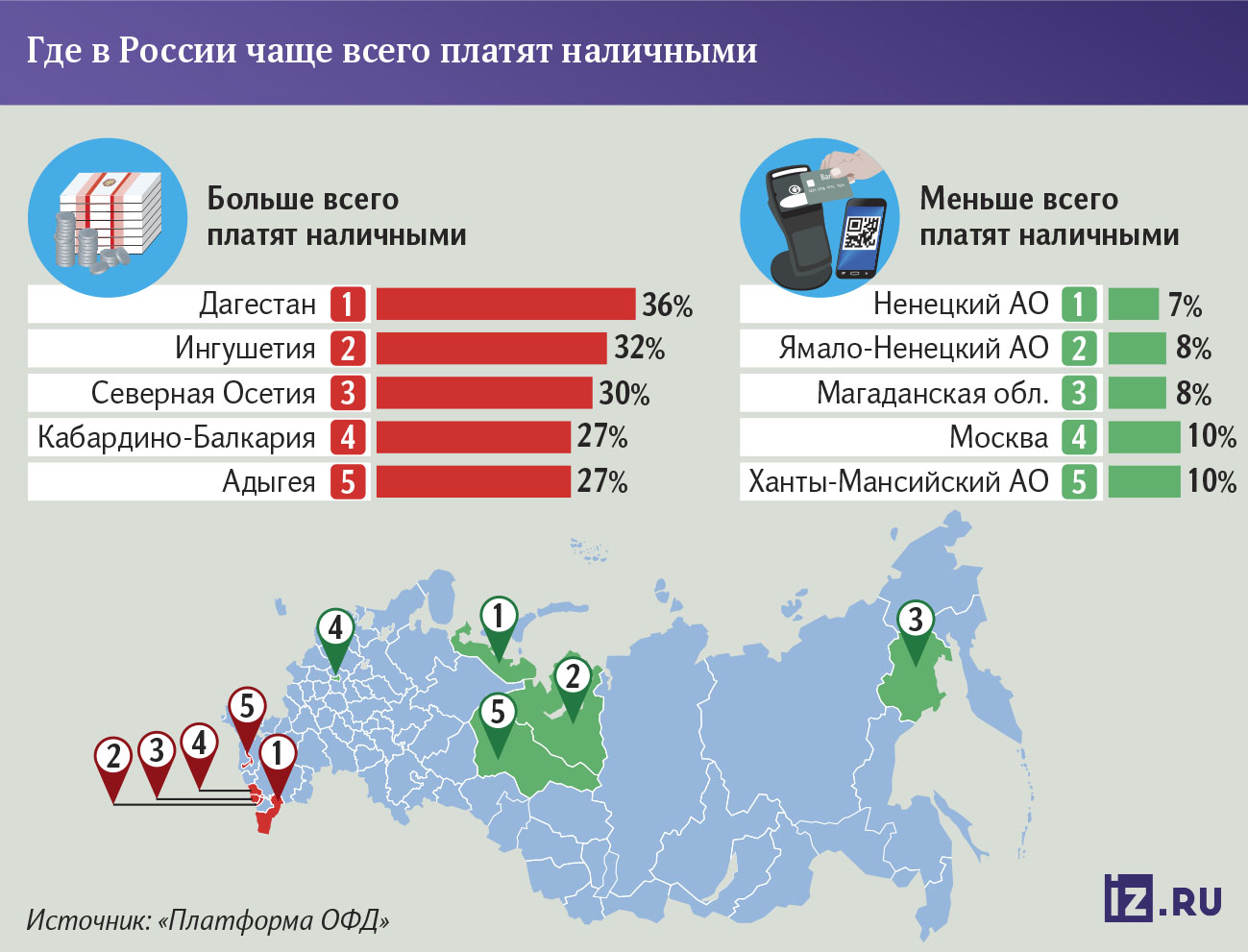
Most often, cash is paid in the southern regions of the country. According to the OFD Platform, Dagestan is in the lead — such payments account for 36% of purchases there. This is followed by Ingushetia (32%), North Ossetia (30%), Kabardino-Balkaria and Adygea (27% each). Paper money is used least often in the North: less than 8% in Nenets, Yamalo-Nenets Autonomous District and Magadan region. In Moscow, this figure is 10%.

One of the reasons for the growing popularity of cash is the increased burden on small businesses. Some small companies prefer to work for such a calculation in order to reduce costs, said Mikhail Zeltser, an expert on the stock market at BCS World of Investments. According to him, Internet and communication outages and disruptions in payment services also play a role.

Additionally, entrepreneurs were affected by tax changes — an increase in VAT, a decrease in the revenue threshold for its payment by companies on the simplified payment system and the extension of the fee to bank acquiring services, Olga Belenkaya, head of the Macroeconomic analysis department at Finam Federal State Enterprise, recalled.
In addition, against the background of economic and geopolitical uncertainty, people tend to have a reserve of money in case of unforeseen situations, said Natalia Milchakova, a leading analyst at Freedom Global. At the same time, Russians' incomes have increased in recent years. According to Rosstat, from 2022 to 2025, nominal salaries increased by more than 1.5 times, and real incomes of the population increased by 14%. This allows you not only to spend more, but also to save some of the funds, including in cash.
Izvestia sent a request to the Central Bank.
What is most often paid for in cash
Most often, Russians pay with cash when buying car supplies, paying for repairs and hotel services. According to the OFD Platform, the share of such calculations reaches half in the transport segment, a third in construction and repairs, and slightly lower in the purchase of furniture and accessories, household appliances and fuel.
Among the services, hotels are the leaders, where almost half of orders, medical care and entertainment are paid in cash.

Experts explain the high popularity of cash in the field of repairs and automotive products by the peculiarities of the market. Many of the jobs are performed not by large companies, but by sole proprietors, self-employed or private craftsmen, Natalia Milchakova explained. According to her, not all of them are willing to spend money on equipment for accepting cashless payments.
In addition, a significant part of such services are provided by migrant workers. Against the background of the strengthening of the ruble, the number of foreign workers in Russia has increased, which also supports the demand for cash payments, the expert believes.
The situation with hotels is slightly different. Many foreign tourists still face difficulties when paying with Russian cards. Therefore, hotels, especially in Moscow, St. Petersburg and resort towns, continue to actively accept cash, Natalia Milchakova noted.

Another reason is the economics of business. In the automotive, building materials, and hotel services segments, the average bill is usually large, while profitability remains relatively low. The acquisition fee of 1-3% can significantly reduce the seller's profit, so entrepreneurs often offer customers discounts for cash payments, explained Alexey Kuzmin, Chairman of the Board of JSC National Savings Bank.

In addition, there are many one-time orders and non-standard services in these areas, where the payment often takes place directly on the spot. In such a situation, paper money remains the easiest and fastest payment method for both the client and the contractor, added Evgenia Veselova, an expert at the financial marketplace Compare.
For small businesses, switching to cash can really reduce costs. Savings on acquiring fees alone can reach 2%, said Dmitry Batyushenkov from the OFD Platform.
At the same time, the expert emphasizes that the growing popularity of cash does not mean that sellers can abandon cash discipline. Even in case of communication outages, modern equipment is able to work independently and issue receipts, which are later automatically transmitted to the fiscal data operator. But accepting money without a check is considered a violation of the law, he recalled.
How does the growing popularity of cash affect the economy
The increase in the share of cash goes against the course of the authorities to increase the transparency of the economy. In recent years, the government has consistently expanded the use of non-cash payments, the SBP and the digital ruble, as well as increased control over shadow employment and unaccounted-for settlements. President Vladimir Putin previously called the whitewashing of the economy one of the key tasks, instructing to reduce illegal employment and strengthen control over the circulation of paper money.

As a rule, the more settlements take place outside the banking system, the lower the transparency of the economy and the more difficult tax control is. As a result, some operations go into the gray zone, which reduces tax collection, said Alexey Kuzmin from the National Savings Bank.
For citizens, cash is convenient because it allows them to pay even in case of communication failures and provides greater privacy. However, such money can be lost or it can be stolen. In addition, customers are deprived of cashback and other bonuses that banks offer for card payments, the expert added.
For businesses, the advantages are savings on acquiring and instant access to revenue. Among the disadvantages are the costs of cash collection and storage, as well as restrictions on cash payments between companies.
Cheaper acquiring for small businesses could stimulate non-cash payments, says Denis Astafyev, founder of the SharesPro fintech platform. According to him, the expansion of the use of SBP and tax incentives for citizens who choose to pay by card can also help. The digital ruble may become an additional alternative to cash, but its mass adoption is expected no earlier than 2027-2028.

According to Denis Astafyev's forecast, by the end of 2026, the share of cash payments will stabilize in the range of 28-31%. A steady return to the growth of payments through banks is possible only with a reduction in fees, the development of SBP and increased control over shadow payments.
Thus, the growth in the share of cash shows that the payment habits of Russians are changing not only under the influence of technology. Equally important are economics, regulation, and the level of trust in infrastructure.
Переведено сервисом «Яндекс Переводчик»
