- Статьи
- Society
- Carlson, who brought childhood back to millions: 100 years since the birth of Spartak Mishulin

Carlson, who brought childhood back to millions: 100 years since the birth of Spartak Mishulin

2026 marks the 100th anniversary of the birth of Spartak Mishulin, an actor whom millions of viewers remember as charming Carlson, the pan Director from the "13 Chairs Tavern" and the elusive Said from the "White Sun of the Desert". There was a difficult fate behind his national fame: his mother's arrest, several years in a penal colony, a serious injury, and only then a scene that he did not leave until his last day. About how an actor with an unusual name became an All—Union favorite, his main roles in theater and cinema - in the material of Izvestia.
The childhood of the future star: difficult years and an unusual fate
Spartak Mishulin was born on October 22, 1926 in Moscow. His mother Anna Vasilyevna Mishulina held a high position in Soviet industry, and her brother Alexander Mishulin was a prominent researcher of ancient history, professor and rector of the Academy of Social Sciences. It was he who gave his nephew the name Spartacus in honor of the famous Roman gladiator.
This name turned out to be almost symbolic. Since childhood, the life of the future artist developed in such a way that he had to constantly fight for a place in the sun and start all over again. The boy grew up in an incomplete family, his mother and uncle were responsible for his upbringing. He didn't know his father and often joked about it. According to one version, he was a gypsy baron, according to another, a writer. The mother remained silent.

Biographers believe that his father could have been the famous Soviet writer Alexander Fadeev, with whom the actor's mother had a long-term affair. Mishulin received her last name, and the patronymic Vasilyevich, presumably, he inherited from his stepfather or grandfather.
By Soviet standards, the family lived well. However, in 1937, everything changed. Mishulin's mother was arrested as an "enemy of the people" and exiled to Tashkent. Spartak was only 11 years old. He lived with his stepfather, then with his uncle, and often ran away from home. According to the actor's recollections, his stepfather was a drinking and aggressive man, so the boy spent most of his time on the street or traveling with friends in freight wagons.
Before the war, the mother was released, and in 1941 the family was evacuated to the Gorky region. Spartacus, who had not yet reached military age, was eager to go to the front, but each time he was brought back. One day, he saw an advertisement for an art vocational school and, deciding that they teach artists there, he enrolled in it without hesitation. Imagine his surprise when he found out that the school trains gunners. The recruited students were loaded onto a train and taken to Anzhero-Sudzhensk.
The long road to fame: the years before national fame
At the artillery school, Spartak did not lose his head — he enrolled in an amateur activity club and spent all his free time there. Together with his comrades, he staged plays, came up with holiday scenarios and conducted concerts himself. But soon an event occurred that almost ruined his life. Fascinated by writing the play, Mishulin took the sheets, on the backs of which Stalin was depicted, and continued to write on them.

Spartak Mishulin as Zhuv in the play based on Lev Slavin's play "Intervention". Moscow Academic Theater of Satire.
"I was writing something all the time: poems, short stories. Graphomancy is so childish. But there was no paper. And then they brought us portraits of Stalin. And on the back is a blank piece of paper. And I folded one such poster in half, then again, and wrote on these quarters," the actor said in an interview.
Mishulin was convicted of this offense and sent to a labor camp, where he was assigned to a tractor brigade. But even in prison, he continued to do what he loved — he staged amateur performances and even organized a choir. However, the trials did not end there. During the harvest, young Spartacus fell asleep right in the field and did not hear the approaching tractor. The tractor driver did not notice him, and the car passed over him with tracks.
According to the actor, the doctors did not give him a chance — after a serious injury, he was literally pieced together. It took about eight months to recover. After that, Mishulin was transferred to a lighter job as a water carrier.
After being released, Mishulin got a position in a small House of Culture in the Kalinin region. He was helped in this by a friend from the labor camp, who was released at the same time as the young man.
"And there was one man among the prisoners — he had a political article— who sang in my choir. It so happened that we were being released at the same time. And this man tells me that his wife is the director of a cultural center in the village of Brusovo in the Kalinin region, now Tver region. "Come with me, you'll be in charge of your wife's amateur art activities." And I agreed," the actor said.

According to Mishulin, the first thing he did in Burusovo was to repair the diesel engine, return the light to the village, and then organize an artillery brigade. The 16-year-old's organizational talent was not ignored, and he was offered the position of artistic director at the regional Palace of Culture. Two years later, Spartak successfully passed the exams and entered the theater studio at the Kalinin Drama Theater. Since his sophomore year, he began to actively participate in productions.
The theater of satire and the birth of a legend
In 1960, after touring the Kalininsky Theater in Moscow, Mishulin was invited to join three metropolitan groups at once.: Lenkom, the Theater of the Soviet Army and the Theater of Satire. He chose the Theater of Satire and remained faithful to it until the end of his life.
On this stage, he performed many roles: Ostap Bender in "The Twelve Chairs", Khlopov in "The Inspector General", the king in "An Ordinary Miracle", the white general Charnota in "The Run". However, the main role of his life was Carlson from the play "The Kid and Carlson, who lives on the roof."
Mishulin was not only the performer of the main role, but also the director of the production. Over the years of his work in the Satire Theater, he played Carlson more than 2 thousand times, traveling the whole country with the production. For the role, the actor had to spend hours in complex makeup, use a fake belly and hover above the stage on cables.

When asked if he was tired of this role, he invariably replied: "I can bring childhood back to people, especially my peers, who didn't really have it because of all kinds of wars. Isn't it enough to give people back their childhood?"
The main films of Spartak Mishulin
Mishulin came to the cinema as a mature actor. His debut work was a cameo role in Valentin Pluchek's comedy "The Apple of Discord", which was released in 1962. However, the real fame came thanks to the role of the pan Director in the humorous program "The Tavern "13 chairs". The program became one of the most popular on Soviet television. Leonid Brezhnev really liked the show, and the Secretary General did not miss a single issue.
Mishulin appeared on the screen for 15 years. He was accompanied on the set by Olga Aroseva, Valentina Sharykina, Alexander Belyavsky, Mikhail Derzhavin, Georgy Vitsin and many other artists.
The actor became even more famous for the role of Said in Vladimir Motyl's film "The White Sun of the Desert" (1968). Filming was not easy. The scene where Sukhov meets Said for the first time was filmed three days in a row in 60-degree heat. The actor was buried in hot sand, he had to eat and drink with a spoon from the hands of colleagues. Besides, he had to shave his head for the role.

Later, the actor recalled that, returning to the theater, he had to put on a wig every time so as not to provoke the anger of Valentin Pluchek, the chief director of the Satire Theater, who did not like it when actors asked for filming.
In 1971, two significant films with Spartak Mishulin were released at once — "The Heritage of the Republic" directed by Vladimir Bychkov and the TV play "The Kid and Carlson, who lives on the Roof" by Margarita Mikaelian. The latter became a film adaptation of the play of the same name starring Mishulin. Andrei Mironov and Tatiana Peltzer also starred in the film with him.
Other notable works of the actor include the role of an Indian chief in the film "The Man from Capuchin Boulevard" (1987), the role of the father of the main character Dmitry Puzyrev in Leonid Gaidai's comedy "Private Detective, or Operation Cooperation" (1989) and the role of restaurant director Archibald Archibaldovich in the film adaptation of Bulgakov's novel "The Master and Margarita" (1994). His last film work was the film "On the River Maiden" directed by Vasily Panin. The film was released in 2006.

The actor's personal life
Spartak Mishulin has always enjoyed the attention of women, especially after his success in the "13 Chairs Tavern". However, his personal life was connected with one woman, Valentina Kazakova. They met in 1969 in the corridors of the Ostankino television center, where Valentina worked as an editor. She was 19 years younger than the actor.

A shot from the filming of the movie "The tavern "13 chairs"
They got married three years later. The couple lived together for more than 30 years. All this time, Valentina remained Mishulin's main person and reliable support. She was there during periods of creative success and during difficult trials.
In 1979, the couple had a daughter, Karina. At that time, Mishulin was already over 50 years old. She continued her acting dynasty and became an actress, playing, in particular, in the popular TV series "Fizruk" and "Kitchen".
According to the memoirs of his relatives, Mishulin was very attached to his daughter. Despite the busy schedule of performances, rehearsals and filming, he tried to spend as much time with Karina as possible.
Family drama and the last years of his life
In the last years of his life, Spartak Mishulin continued to work, despite his health problems. He remained one of the leading actors of the Satire Theater and continued to act in films.
In June 2005, the actor was hospitalized with heart failure at the Cardiac Surgery Center in Moscow. And less than a month later, on July 17th, his heart stopped forever. Mishulin was buried at the Vagankovo cemetery. A civil memorial service was held at the Satire Theater, where the actor served for more than 40 years.
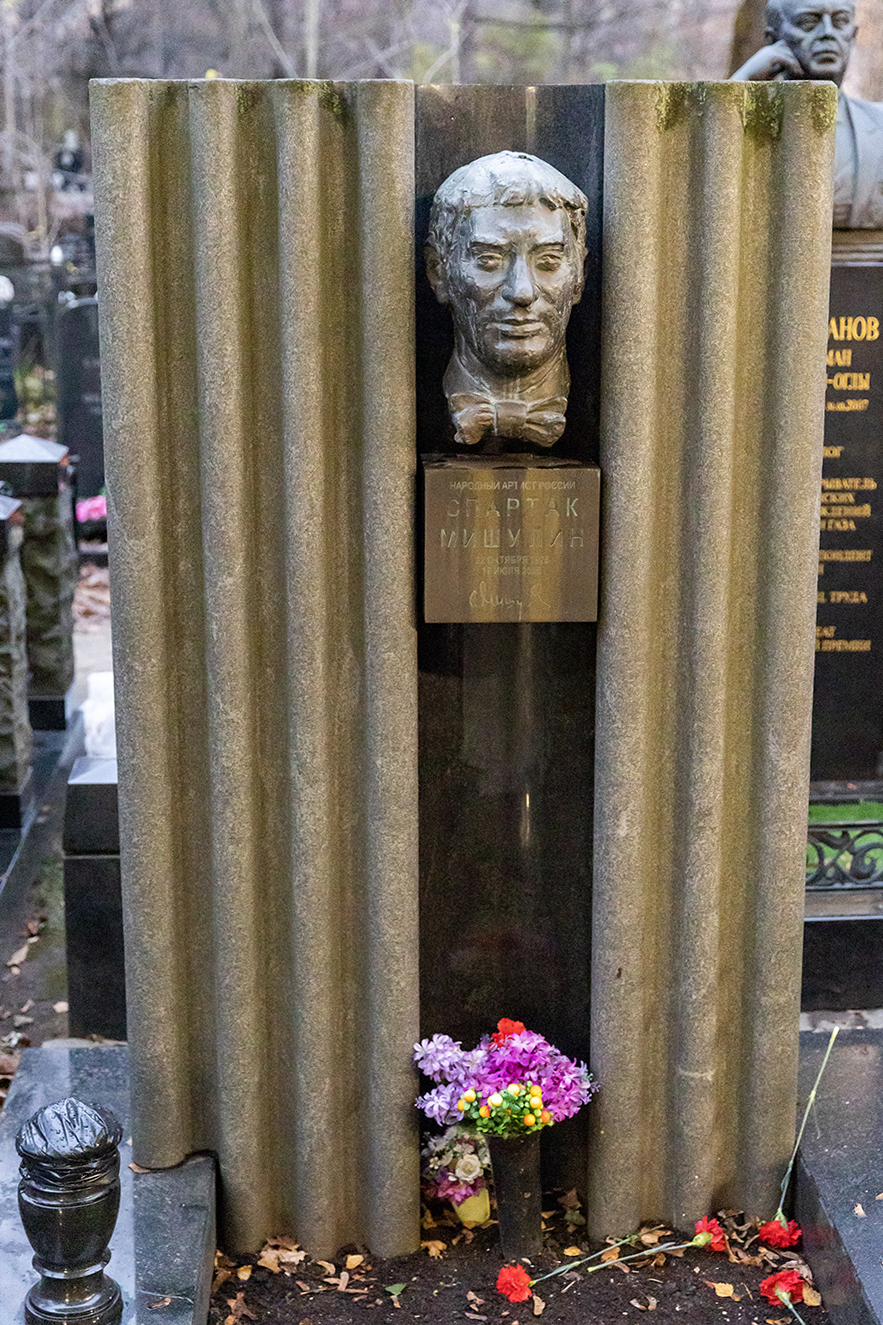
After the death of the artist, his family became the focus of attention due to statements about a possible relationship with Mishulin. Officially, Spartak Vasilyevich had one daughter— Karina. However, a few years after his death, people appeared in the media claiming to be his relatives. The most famous was the story of actor Timur Yeremeyev.
In 2017, Yeremeyev publicly stated that he was Mishulin's illegitimate son. He claimed that his mother Tatiana met Mishulin in 1971 during the filming of the film "The Heritage of the Republic." Later, a DNA examination was carried out, the results of which Yeremeyev and his representatives regarded as confirmation of kinship. The story received a wide public response and became the subject of legal proceedings.
In 2018, Eduard Sorokin, a resident of Tver, declared his relationship with Mishulin. He called himself the actor's grandson and appealed to the court, seeking to establish kinship and inheritance rights. In April 2019, the court refused to satisfy his claims.
Interesting facts about Spartak Mishulin
During his life, Spartak Mishulin was awarded many awards and titles. In 1981, he was awarded the title of "People's Artist of the RSFSR." He was a laureate of the State Prize of the Russian Federation in Literature and Art in 1997, awarded the Order of Honor (1996) and the Order of Friendship (2002). His other awards include the I. Smoktunovsky Prize and the Lumiere Brothers Prize.

Mishulin had many hobbies unrelated to the theater. He loved books and tried to write himself when he was young. The actor was also an avid collector of clowns. His daughter recalled that on his birthdays he was given figurines, paintings or statuettes with circus performers, which he enthusiastically collected. This childhood trait — a love of toys and everything bright — remained in him until the end of his life and, perhaps, helped him to play Carlson so convincingly.
There was also an impressive collection of badges in the artist's apartment on Nastasinsky Lane in the center of Moscow. And each of them had its own story. The collection included commemorative copies issued for anniversaries and other important dates of enterprises, institutions and organizations. The collection occupied about seven square meters, and the total weight, according to the artist's wife, was about 40 kg — two buckets of 20 kg each.
In 1988, Mishulin made his directorial debut by directing the children's play "A Barrel of Honey", a philosophical fairy tale—parable that raises the themes of the struggle between good and evil and the search for happiness. The production went on for a long time and with constant success on the stage of the Satire Theater. The artist did not limit himself to acting and directing, continuing to try himself in new roles even in his declining years.
Переведено сервисом «Яндекс Переводчик»
