
The region is in hot demand: why the world is sharply interested in Central Asia

In mid—September, Seoul hosted the first ever "Republic of Korea-Central Asia" summit, which was attended by the leaders of the six countries. In general, the Central Asian region has been receiving increased attention from European, American and Asian politicians for several years. Experts cite the geopolitical conjuncture and high rates of development of the post-Soviet republics among the reasons. "Izvestia" investigated the situation.
Five plus Seoul
On September 16-17, Seoul hosted the first "Republic of Korea—Central Asia" summit, which was attended by the leaders of Kazakhstan, Uzbekistan, Kyrgyzstan, Turkmenistan, Tajikistan and South Korea.

During his visit, President of Kazakhstan Kassym-Jomart Tokayev not only addressed the general meeting, but also held separate talks with the South Korean leadership. As a result, 12 documents were signed, and relations between the two countries were upgraded to the level of a comprehensive strategic partnership.
Last year, according to Tokayev, the bilateral trade turnover exceeded $3 billion, and now the task is to double this figure, including using high-value-added products. ""I think it's important to prepare a roadmap for industrial cooperation, including promising localization projects,"" he said.

President of Uzbekistan Shavkat Mirziyoyev also arrived in Seoul early and, during preliminary negotiations, signed 13 documents with colleagues on cooperation in the fields of transport, aviation, agriculture, etc. Turkmen leader Serdar Berdimuhamedov signed the same number of papers. The main one was the investment protection agreement.
During the summit itself, the politicians signed the Seoul Declaration, which detailed the prospects for cooperation. It is emphasized that the Central Asian countries are currently exchanging their natural resources, including rare earth metals necessary for the production of electronics, for ready-made South Korean products.

In the future, the post-Soviet republics would like to establish joint production facilities and exchange specialists. For its part, Seoul is interested in using transport routes in Central Asia, which will allow access to the markets of the Middle East and Europe. It is noted that to implement these plans, similar meetings will be held every two years, the next one will be held in 2028 in Astana.
Summit after summit
In recent years, these five post-Soviet republics have received increased attention from a wide variety of geopolitical centers. In May 2023, Xi'an, China, hosted the first ever summit with the participation of the leaders of China and Central Asian countries. The result was the voluminous Xi'an Declaration, which emphasizes the course towards the development of multifaceted cooperation.

In October of the same year, the first summit in the "5 +1" format was already held with the President of the United States, who was then Joe Biden. The meeting took place on the sidelines of the UN General Assembly in New York. Interestingly, the American leader did not lecture the guests on human rights and democratization, but only noted that he was ready to help with "reforms on the rule of law."
Next, the new US President, Donald Trump, held his meeting with the five leaders in November 2025. At the same time, the format was increased — the negotiations did not take place on the sidelines of another event, but became a separate event at the White House. That meeting was remembered for lavish compliments. For example, Tokayev called Trump a great leader sent from above.
The Europeans are not left out either. The first EU–Central Asia summit was held in Samarkand last April. Representatives of Brussels then promised investments in the amount of € 12 billion and rather cautiously hinted at the need to comply with anti-Russian sanctions.

At the same time, individual European countries are developing their own formats of interaction. Germany has held meetings in the "5+1" format twice in the last three years. A similar event was held last May with the participation of Italian Prime Minister Giorgi Meloni. The leaders of France and Great Britain also flew to the Central Asian region.
In addition, Japan, the Persian Gulf countries and Turkey have become more active. Finally, we must not forget about the serious interest from Russia. Moscow maintains contacts with its neighbors in a bilateral format, communicates with individual leaders within the SCO, BRICS, EAEU, and CSTO, and holds its summits according to the same "5+1" scheme.

An island of stability
There are several reasons for this activity. First, in the context of severe turbulence in Eastern Europe and the Middle East, the Central Asian region looks like an island of stability. There is no fighting here, and the existing disagreements are becoming less acute.

In particular, the border conflict between Kyrgyzstan and Tajikistan has subsided. Earlier, skirmishes periodically broke out on the line of contact, resulting in dozens of deaths. Recently, however, Bishkek and Dushanbe have been able to come to an agreement. Last year, after long and difficult negotiations, they signed a border agreement, and this year they completed the delimitation process, as a result of which relations became much calmer.
The second important point concerns the rather noticeable development of the five republics. The population of the region is increasing. A quarter of a century ago, 56 million people lived here, now it is 85.2 million. The region's total economy is also growing by 5-6% per year, which is higher than in most developing countries. In such conditions, Central Asia is becoming a promising market.
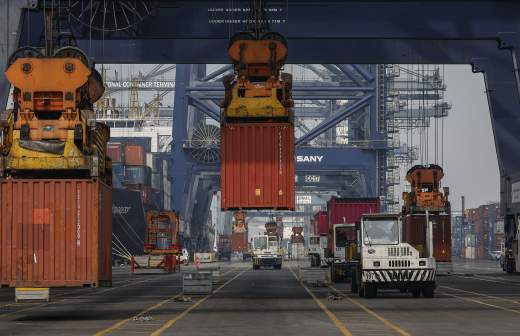
The third reason is the increased importance of the region's transport and logistics capabilities. Previously, the Central Asian countries were considered peripheral and dependent on other centers of power because they had no access to the sea. Now the West and East have begun to look for and pave ways to bypass Russia, so they are paying more and more attention to its southern neighbors.
I must say that serious steps are already being taken in this regard. Last spring, construction of the China–Kyrgyzstan–Uzbekistan railway began. The length of the branch line will be 532 km, and a significant part of it will pass through mountainous terrain, so dozens of tunnels and bridges will have to be built. It is assumed that in the future the line will be connected to the canvas in Iran and Turkey, and eventually it will become part of the new Silk Road.

Finally, the general situation in Eurasia contributes to increased attention. After the start of the conflict, the West imposed many anti-Russian sanctions, trying to isolate the Russian Federation from the global economy. The Central Asian countries help Moscow with parallel imports, therefore they are important for Russia. Brussels is trying to prevent this cooperation, and as a result, both centers of power are fighting for influence in Central Asia.
For the United States, the key plot is the confrontation with China, which also holds strong positions in five republics. Accordingly, Washington is also trying to gain a foothold here, pushing Beijing aside. At the same time, the Central Asian countries follow a multi-vector approach in their foreign policy, preferring not to make a final choice in favor of one or another major power, which allows them to benefit from all sides.
What the experts say
Central Asia is turning into one of the key global regions, Igor Shestakov, a political scientist and director of the Kyrgyz Center for expert initiatives "Oi Ordo", is convinced.
— We remain a zone of stability and predictability, which is very important now that Eurasia is being shaken by various crises. Plus, our region is rich in natural resources, such as rare earth metals, which have become critically valuable raw materials. I would also like to draw your attention to the fact that Azerbaijan has officially joined the consultative meetings of the heads of our states, which means that our approach is also in demand outside the region," he emphasizes.

At the same time, political scientist Rustam Burnashev advises not to overestimate the growing interest in Central Asia. He admits that external partners want to gain access to natural resources (hydrocarbon raw materials, uranium, rare earth metals) and transit opportunities in the region, but this attention is situational.
— For example, if the fighting in Ukraine stops, will the Middle Corridor bypassing the Russian Federation remain relevant? I have big doubts. We have already seen a surge of interest in the region during the US war in Afghanistan, then everything quickly subsided, according to the same scenario, the situation may develop now," the expert believes.
Переведено сервисом «Яндекс Переводчик»
