
Bones in the house — joy in it: what Mexicans celebrate on the night of November 1st

The cross—cutting question of the book is what about the veneration of death in Mexico has its roots in pre-Columbian antiquity, and what came along with Europeans and Christianity? The author of "Day of the Dead" asks this question in relation to many described rituals, customs, religious buildings, mythological characters and artifacts. Critic Lidia Maslova presents the book of the week specifically for "Izvestia".
Ksenia Yamasheva
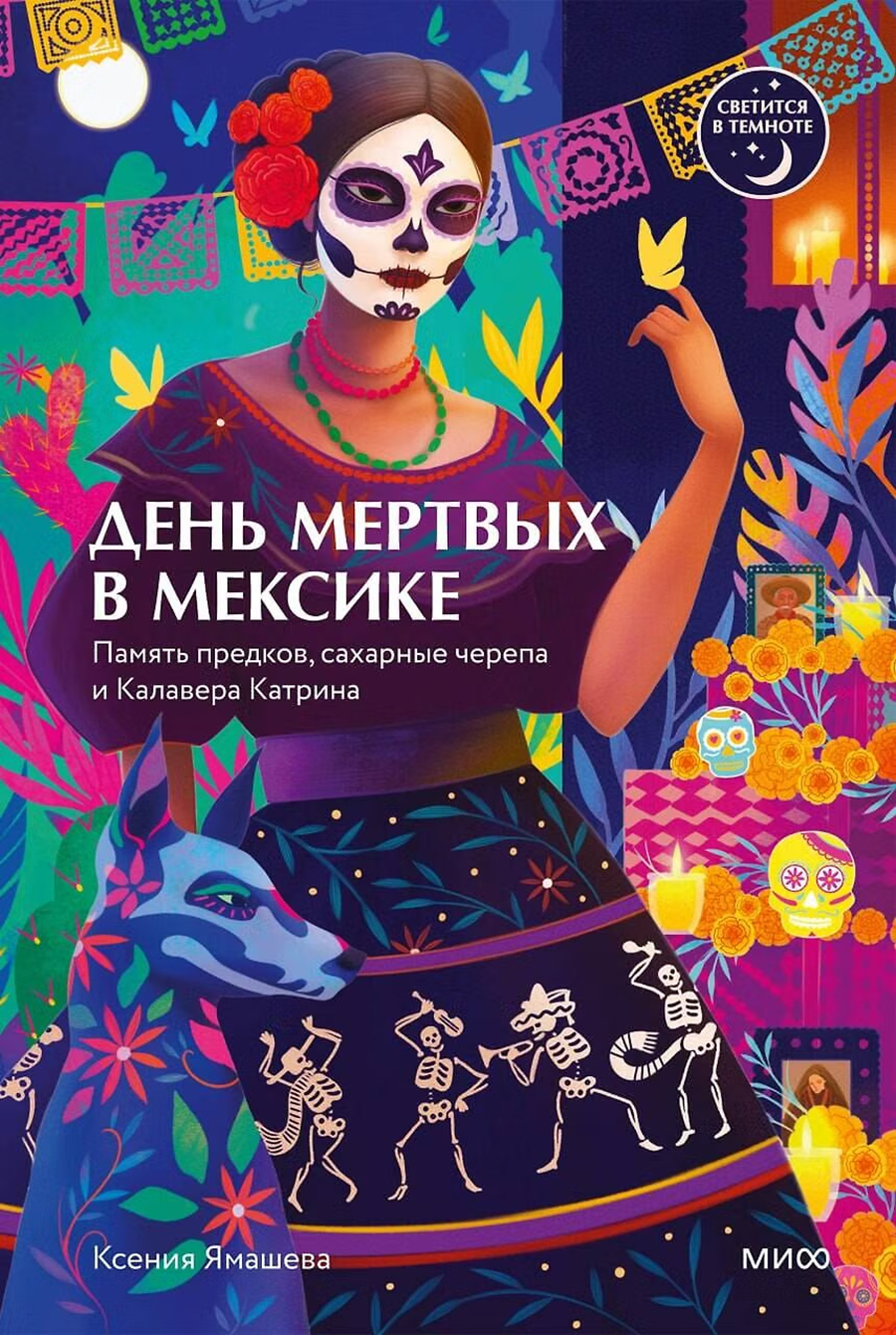
"Day of the Dead in Mexico. Ancestral Memory, Sugar Skulls and Katrina Calavera"
Moscow: MIF, 2026. 224 p.
Ksenia Yamasheva, a specialist in the fine arts and iconography of pre—Columbian Mesoamerica, begins her book with a short but expressive immersion in the atmosphere of the Day of the Dead, Dia de los muertos, the world-famous Mexican holiday: "Mexico City, the night from October 31 to November 1. The streets are especially noisy, all the paths and sidewalks are covered with orange flower petals. The wind flutters the delicate colorful flags with skeletons carved on them. Painted skulls cheerfully grin from the counters, advertising posters and multi-tiered altars standing at every house." Noting the obvious similarity (especially to the layman's eye) Compared to the Anglo-Saxon Halloween, the culturologist emphasizes an important nuance: unlike the finally vulgar Halloween, the original meaning of which few people remember, the Day of the Dead still retains "deep values" under a bright exotic wrapper that attracts tourists.
Starting with Saint Pascual, revered in Mexico and Guatemala, depicted as a skeleton, Yamasheva moves on to the modern phenomenon of Santa Muerte, about which there are still few full-fledged studies that competently clarify its origins. Yamasheva concludes her story about this cult, which is gaining popularity in certain circles, and whose first mentions date back to the 1940s, with a warning that this religion of marginals, closely linked to criminality, should in no case "be romanticized and presented in an attractive context of ancient cultural heritage." This is generally the principled position of the researcher, who repeatedly reminds that one should not look for more ancient cultural influences where they actually do not exist. Yamasheva argues with some modern scientists who are tempted to search everywhere for pre-Hispanic roots: "It is tempting in the field of religious beliefs, traditions and the study of such aspects of human existence as the perception of the phenomenon of life and death and the experience of loss through the prism of a system of spiritual ideas." However, this approach, which ignores the influence of Spanish colonization and Christianization, "inevitably leads to a distortion of historical reality and neglect of significant aspects of what the current Mexican mentality is based on."
The first part of the book, "Death in Pre—Columbian Mesoamerica," provides an opportunity to see the universe through the eyes of an ancient Mesoamerican, to get acquainted with the three—component structure of the human soul according to the Aztec tradition, and to make an excursion into the mortal mythology of Mesoamerican peoples — primarily the Aztecs and Maya. Their special attitude to death seems inextricably linked to the ancestral cult underlying the Mesoamerican religion: "... it was believed that the ancestral bond does not end with the death of a representative of a particular family member, and thus our ancestors are always in constant contact with us. They were revered, gifts were brought to them, and they were asked for help and support."

""Death in Mexican society of the XVI—XX centuries" and "Representations of death in modern Mexican society" tell about the reflection of death in fine art (in particular, in the cartoons of Jose Guadalupe Posada, the creator of the glamorous Calavera Katrina— a socialite in the world of the dead) and about specific ritual practices. In this part, the book becomes especially fascinating, turning almost into a mystical thriller, telling about very unusual ways to cope with the grief of losing loved ones. Among them, for example, is a somewhat frightening, but at the same time touching, unique custom of the modern Maya living in the states of Yucatan and Campeche: after a set period of time, the bones of the dear dead are supposed to be exhumed, put in order, cleaned with brushes, rags and water (along the way, telling the deceased the latest news from the life of his family) and make elegant ossuaries for them, resembling a miniature apartment building. For the living, as the author of the book notes, this is not only a way to honor the memory of the deceased, but also an opportunity to be close to those who are no longer there.

At the end of her research, Yamasheva poses the question bluntly: "So is there a cult of death in Mexico?" Although he avoids an unambiguous answer, limiting himself to the evasive "yes and no." According to the author of the book, if one can talk about the Mexican death cult, it is least of all connected with attempts to reconstruct the religious beliefs of the Indians of Ancient Mesoamerica. At the present stage, it is part of the cultural image of the country, thanks to which it is recognized in the international arena and which the state has made some efforts to form.: "In the 1980s, Mexico paid increased attention to the construction of altars and the celebration of the Day of the Dead as an important component of the formation of national identity." The state cultural policy aimed at making death a symbol uniting the nation has borne fruit and led to the fact that death has become paradoxically perceived as a "cultural good." ""It became even more prestigious, so to speak, when the Day of the Dead was recognized as an oral and intangible UNESCO heritage in 2003: "death has gained aesthetic, social and even ritual success in the social structure of Mexico."

It's hard to argue with the Mexican aphorism "Death is something that everyone has and no one can take away from them," but I would still like to understand what psychological and mental characteristics of the Mexican people have made it possible over the centuries to form such a heroic and at the same time somewhat tragicomic, and sometimes frankly familiar attitude towards the inevitable end of any human life, as well as such a strong craving for mortal art. Summing up a purely artistic summary in the book's finale ("Death is what visually distinguishes Mexican culture from others"), Yamasheva gives the floor to an authoritative cultural critic Octavio Paz, who understands the Mexican mentality from the inside out, to explain the psychological background. In his opinion, the fearless Mexican indifference to death is directly related to indifference to life, which is not highly valued. Paz talks about the specific relationship of his compatriots with death romantically and sublimely, but at the same time with a slight tinge of bitterness: "...Sugar or paper skulls; brightly colored skeletons — our popular images are always a mockery of life, a confirmation of the insignificance of human nature. On Memorial Day, we decorate our houses with skulls, eat bread in the form of bones, and entertain ourselves with songs and jokes that mock the pale death. But all this boastful familiarity doesn't free us from the question we all ask ourselves.: What is death? <...> And every time we ask ourselves about it, we end up just shrugging our shoulders: what do I care about death if I don't care about life?"
Переведено сервисом «Яндекс Переводчик»
