Son for father: two generations of Leonovs on the stage of Lenkom


There are stories that are dangerous to bring back to the stage. Alexander Vampilov's "eldest son" is just one of them. After Vitaly Melnikov's 1976 film, any new reading inevitably finds itself in the shadow of Sarafanov's old apartment. Vladimir Pankov, the artistic director of the Lenkom Mark Zakharov Theater, did not pretend that this shadow did not exist. On the contrary, he invited Andrey Leonov to play the famous role of his father, who would have turned 100 on September 2. Izvestia attended the pre-premiere screening.
From father to son
The director insists that this is not a "Danish" performance, but a sincere dedication to a beloved artist from the troupe and a beloved father from his son. Therefore, it is based not only on the play by Alexander Vampilov, but also on the book by Evgeny Leonov. Or rather, only three of the many letters to his son Andryushka that the People's Artist wrote during the tour.
The idea looks both complementary and difficult to implement. On the one hand, there is no desire to simply "play" with the biography of the famous father or mechanically repeat the famous film. On the other hand, it is difficult to get rid of the comparison.
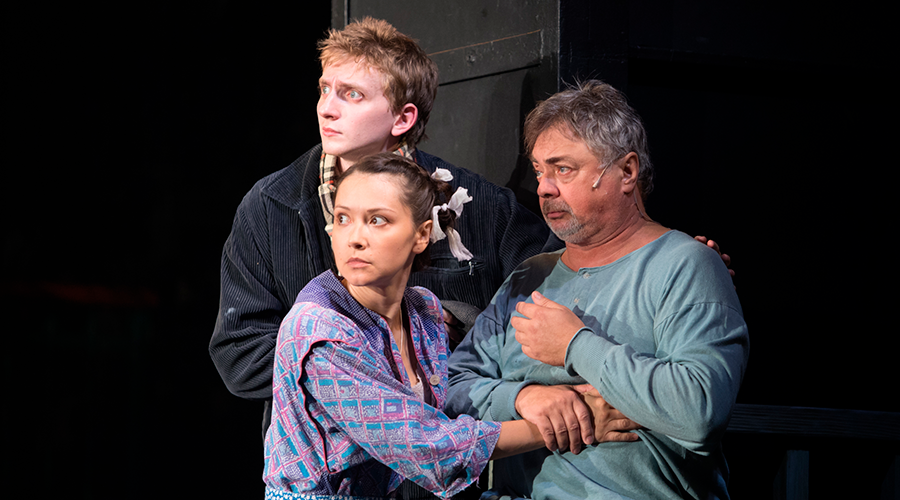
Melnikov's painting is too strongly connected with the acting personality of Evgeny Leonov to be reproduced in the theater half a century later. In the film, young Nikolai Karachentsov and Mikhail Boyarsky were next to the actor. Lenkom does not dispute this memory. They're talking to her.
The first thing viewers hear is an excerpt from the Leonovs' personal correspondence. In the preface to the book, Evgeny Pavlovich explained that for many years he had been writing to his son from different cities and trying to talk to him about everyday life, life, profession, love and human qualities. Fragments of letters appear at the beginning, middle and end of the play. They are read by boys of different ages — Nikita Kudryashov, Egor Furnika, Matvey Sidorov, Mikhail Sidorenko. And then, to the applause of the audience, Sarafanov himself appears. And, in fact, for the next two hours he will talk to the audience about the same thing.

Somewhat overweight, tired, and battered by life, the hero slowly crosses the stage, takes out a bottle of clear liquid, pours a faceted glass to the brim and drinks it in one gulp. And then, like a dream come to life, one of the most touching stories of Soviet drama begins.
Two young men— Vladimir Busygin (Ilya Halmurzaev) and Semyon Sevostyanov, and popularly simply Silva (Stanislav Tikunov), after walking late, are late for the train. In an attempt to find a place to sleep, they decide to take advantage of a random circumstance. Busygin declares himself the illegitimate son of Andrei Sarafanov and receives love instead of the expected exposure.
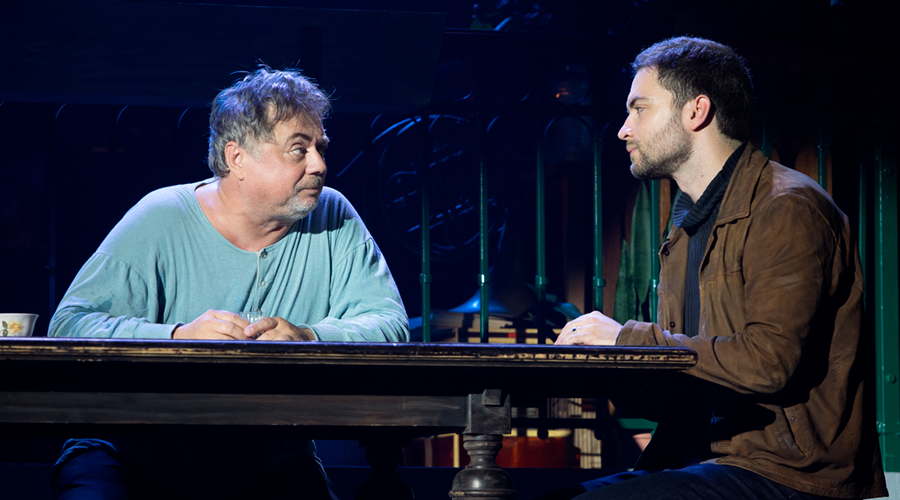
The paradox of Vampilov's play is that a lie can lead to the truth. Sarafanov accepts Busygin as his own son. But not at all because he was convinced by the well-laid-out arguments, or because his conscience was roused for the sins of the past. He's just a very kind man with a difficult fate.
It was this trait that Evgeny Leonov once felt especially accurately. In the published materials of Letters to His Son, the actor reflected on his character and emphasized that it was not so much Sarafanov's naivety as his inability to accept the idea that fatherhood and love could be joked about.

The last letter
Directors often bring the figure of Busygin's "illegitimate son" to the fore. But the father is important here. And not only Sarafanov, but also Evgeny Leonov himself. As the president of the theater, Mark Varshaver, mentioned, the actor did not agree to this job for a long time. And he dared to approach her only after much persuasion. Perhaps he was afraid of the inevitable comparison, perhaps he did not want to bring personal things to the audience.
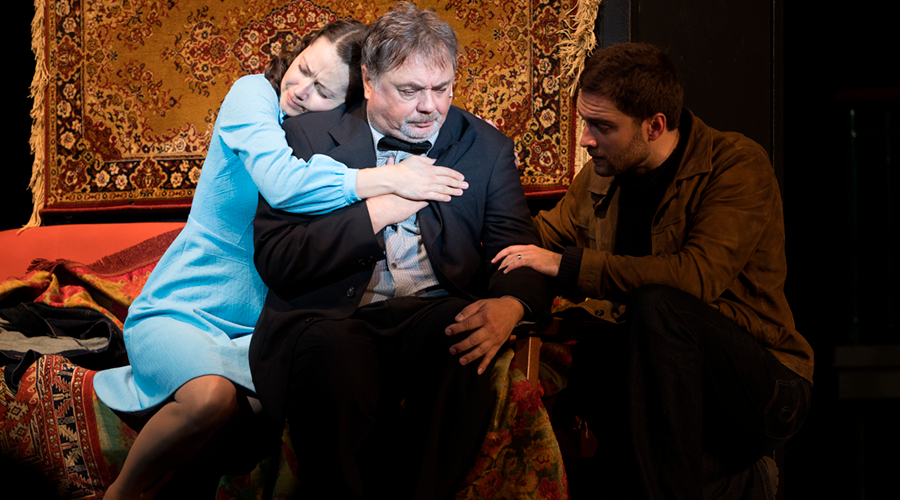
Vladimir Pankov gives this motif an additional dimension. Now Sarafanov's gullibility rhymes with Leonov's real concern for his own son. It turns out to be a performance in which the artificial kinship from the play is unexpectedly combined with the real kinship outside the stage.
The rest of the actors of the play work primarily on its rhythm. They support the rapid movement of the scenes and literally push the story forward, sometimes splashing buckets of life-giving water from what is happening. Characters appear, clash, argue, fall in love, get offended, and get back together. Thanks to this, the play does not freeze in its anniversary dedication and continues to be a full-fledged story about family, chance and human kindness.
But with all the coherence of the ensemble — Vasenka (Alexander Fokin), Nina (Alexandra Volkova), pilot Kudimov (Sergey Yakovlev), Natalia (Zinaida Dianova) — most of the acting inevitably ends up in the background. The production's magnet is already too strong in its very concept. Each of these characters is needed to move the plot, create conflicts and bring the action back to Sarafanov.
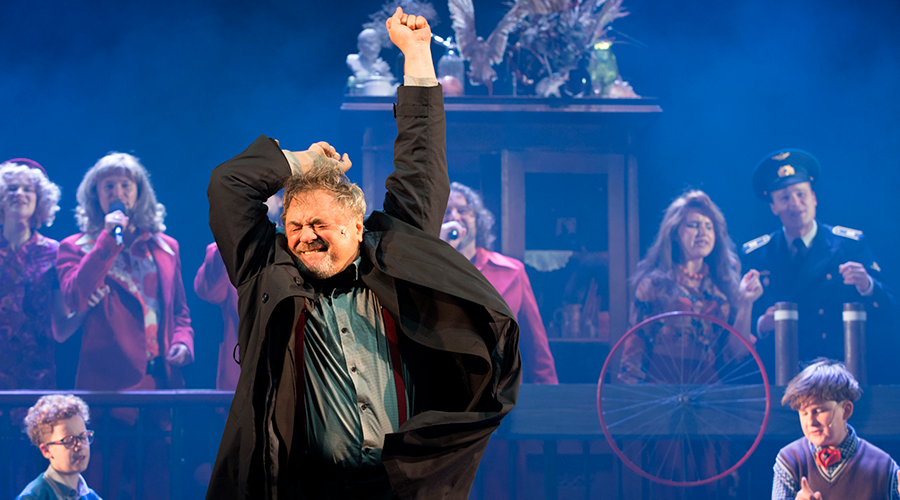
Therefore, the viewer arrives at the last letter not quite the same person who heard the first one. Both Leonovs became truly national actors during their lifetime. And not so much by rank, although both have them, as by recognition. Evgeny Pavlovich — for "Gentlemen of Fortune", "An Ordinary Miracle", "Kin-dza-dza!", Andrey Evgenievich — for theatrical works and, of course, for "Daddy's Daughters". This all-encompassing love is naturally cultivated in the audience, regardless of what is happening on stage. But in the finale, it ceases to be just spectator nostalgia.
In black and white, like chalk on a blackboard, a strict line draws Evgeny Leonov's recognizable profile in the depths of the stage. And then four boys, like chapters from a book come to life, with a heart-rending cry of "daddy!" they see their father off into the distance.
Переведено сервисом «Яндекс Переводчик»
