
Thirst for Life: the labors and days of the Decembrists in Siberian exile

The flower of the Russian nobility, after an unsuccessful attempt at an anti-government rebellion in December 1825, was exiled to Siberia and suddenly found himself in a completely different material, social and cultural environment. Brilliantly educated aristocrats lived for several decades among commoners in isolation from civilization in the middle of Siberian forests. Nevertheless, they managed not only to preserve themselves, but also to form a unique experience of multifaceted interaction with the surrounding reality. Their legacy is still remembered in those parts today. This is exactly what the book created by the staff of the Trans-Baikal Regional Museum of Local Lore tells. Details can be found in the Izvestia article.
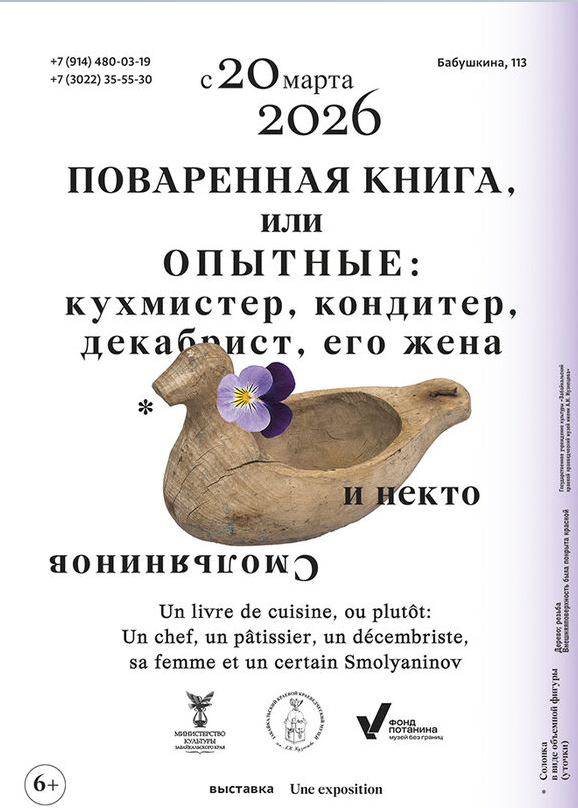
"The Cookbook, or The Experienced Ones: the cookmaster, the pastry chef, the Decembrist, his wife and a certain Smolyaninov"
Chita: Zabaikalsky Regional Museum of Local Lore named after A.K. Kuznetsov, 2026. 240 p.
In 1951, a manuscript of a cookbook was found in the attic of an old house in the heart of Chita. In the second quarter of the 19th century, at least five people carefully copied... a printed edition published in 1818 in Moscow and miraculously found its way beyond the Urals. It is not known for certain who did this and why, although the clean and clear handwriting gives out well-educated people in copyists.
It is also unknown why the manuscript came into the possession of a very influential military mining official, Semyon Ivanovich Smolyaninov (1769-1836), who lived in the same house and in every way welcomed the participants of the uprising exiled to Chita on Senatskaya Square. However, all these circumstances prompted the staff of the Trans-Baikal Regional Museum of Local Lore, in whose funds the manuscript eventually turned out to be, to create a large-scale exhibition and research project dedicated to the history of the Siberian exile of the Decembrists.

The exhibition entitled "The Cookbook, or Experienced: the cookmaster, the pastry chef, the Decembrist, his wife and a certain Smolyaninov" opened in Chita on March 20. It is dedicated to the most mundane aspects of the life of the Decembrists — their daily worries, nutrition, health, leisure, affordable entertainment, and scientific research. It was decided to add a book of the same name to the exposition. As a result, an original edition was published, which included the publication of the mentioned manuscript along with other materials from various museum collections, a catalog of exhibits, a series of detailed local history essays with fragments of memoirs and letters, a modern adaptation of ancient recipes, and even reprint inserts of periodicals of the first half of the 19th century like the Siberian Bulletin or "Housekeeper".

The book begins with a story about how the Decembrists first saw Chita, where and how they settled at first, how 20 people huddled in small rooms and slept in shackles on narrow bunks. With the permission of the stern but noble commandant Stanislav Leparsky and with the broad support of the entire Smolyaninov family, the exiles gradually managed to establish some kind of life, mastered various crafts (Prince Sergei Trubetskoy, for example, learned how to mend stockings superbly, which he was sincerely proud of), took up gardening, watermelons, melons and asparagus were grown in greenhouses, and stocks were made for during the winter (Baron Andrey Rosen, who was in charge of the kitchen at one time, somehow salted 60 thousand cucumbers with his comrades).
In the Chita prison, the Decembrists created an artel with a fairly effective system of mutual assistance, established contact with the outside world through their wives and relatives, were even able to subscribe to some magazines and books, formed a common cash register, organized more or less tolerable meals and treatment, and learned how to carve out time for short leisure.

In their rare "free" hours, they painted, arranged musical evenings, wrote poetry and prose, lectured each other on history, philosophy and literature, learned foreign languages, and engaged in scientific research in the fields of botany, agronomy, meteorology, animal husbandry, archeology, and ethnography. Even today, Nikolai Bestuzhev's "Buryat Economy" or Pyotr Borisov's "Ornithological Fauna of Eastern Siberia", illustrated in detail by him, are of interest.

The vast majority of Decembrists felt an acute inner need for this kind of creative and intellectual activity. But gradually it became a noticeable factor in cultural regulation. Local residents gathered in large numbers under the prison windows to listen to choral or musical performances by prisoners — until then, nothing like this had happened in their area. Ferdinand Wolf, the Decembrist doctor, the only certified specialist for many thousands of miles around, was not the only one who sought help from his cellmates.
The scientific research of the exiles often turned out to be the very first systematic descriptions, for example, of the local flora and fauna or the customs of different peoples of Siberia. The wives of the Decembrists, who followed their husbands into exile, willingly taught the local housewives to cook "other", unfamiliar food, but they themselves, in turn, learned various culinary tricks from them.
"We were the first people from the upper class to come to Siberia, quite accessible and with rules that are completely opposite to what residents are used to seeing in their superiors and superiors... That's why no one kept anything from us... That's why we could study the region in its real truth," recalled Decembrist Dmitry Zavalishin, who later married Apollinaria Semenovna, Smolyaninov's daughter.

The locals were widely sympathetic to these strange exiles. They brought them bread and milk, and who is richer — butter. At first, the Smolyanins' house cooked all the food for the Decembrists (wasn't that why someone rewrote that very cookbook?), and then, when they had their own kitchen, they were constantly supplied with various provisions. Gradually, various shops appeared in Chita, and the city itself turned into an important shopping center, because the Decembrists had some money, and they were willing to pay for what they needed.

Of course, not everything was perfect. Someone, unwilling to engage in heavy "administrative work," threatened to completely leave the artel, someone was frankly poor and boarded in a modest Vologda, unlike the more affluent Moscow. However, these were rather exceptions that only confirmed the general rule: the Decembrists survived and preserved themselves only because they learned to stand shoulder to shoulder. And also because they were open to the world.
A separate and very touching chapter is dedicated to the children of the Decembrists born in exile. The appearance of these "smiles of penal servitude," as the exiles themselves called them, was considered almost a miracle. The prison authorities, in theory, should have harshly suppressed this, but Leparsky turned a blind eye to it, and on occasion could even allocate a small amount for rehabilitation.

There were few children — less than two dozen. But all the adults took care of them as if they were their own. Pampered, treated, taught, mentored. And many families of the Decembrists adopted foster children from among local peasants and, in fact, gave them a start in life. Other "adopted children" eventually made excellent careers, but they always retained the reverent memory of their parents.
Переведено сервисом «Яндекс Переводчик»
