
Tightly sewn: costume designers talked about the elegant underside of filmmaking
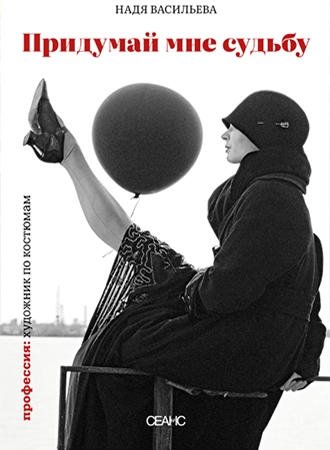
The book by costume designer Nadezhda Vasilyeva, who worked not only with her husband Alexei Balabanov, but also with many famous directors, allows you to look at the process of making a film from the side that the general audience probably does not pay much attention to. Critic Lidia Maslova presents the book of the week — especially for Izvestia.
Nadezhda Vasilyeva
"Invent my fate"
St. Petersburg: Session, 2025. 584 p.
The viewer should not pay attention to the costumes of the characters in a good film, says one of ten venerable colleagues of Vasilyeva, interviewed in detail in the book, Vladimir Nikiforov: "It doesn't always work, but aerobatics when the costume is not visible. If you've watched a movie and started discussing drama rather than costume, it means you've succeeded. The suit doesn't stick out. They started discussing the costume — it's bad."
The author of the book expresses another opinion — that there are no good costumes in a bad movie and vice versa. I really want to argue with this, recalling a recent example from Vasilyeva's own practice — the film version of the popular Soviet cartoon "The Flying Ship", in which the wardrobe of the characters, the variety of fabrics used, the originality of the styles and the crazy extravaganza of color combinations are pleasing to the eye and memorable. But this case of the crushing victory of the costume over all the other content of the film is not mentioned in the book. To talk about her creative career, Vasilyeva chose other works, starting with her debut in Victor Titov's 1989 television series Vaska about the metrostroevtsy of the 1930s. Recalling the famous Tito comedy "Hello, I'm your aunt!", the artist sighs dreamily: "I wish I could make my debut in that movie about my aunt!", but he also talks enthusiastically about "Vaska" as an opportunity to do something avant-garde and show his love for the suprematism of the 1920s.
Since the time of Vaska, the approach to television and film production has changed significantly, and these changes, as it is easy to assume, are not very encouraging for the masters of the old school: "Inspiration has become difficult, because the project is now mostly led not by the director, but by the producer. The producers are trying to start this car, but it seems to me that they treat the costume disdainfully. Their key word is "budget", the main idea is to meet this budget." Recalling the 1990s, when there were almost no budgets, but cinematographers had enough wit, ingenuity and quick thinking, Vasilyeva notes with regret that today, even when there seems to be enough money, ideas are still hard to come by: "Now, with total availability, if there was money, you could do it." That's it. But they began to think less, and sew faster. And this process cannot be accelerated, it turns out to be a hack."

In principle, the ultimate goal of the Vasilievsky book is to at least have a little influence on the fact that not all future costume designers do not always get a hack job.: "I want at least a few people out of a hundred to know how to really work. How we used to work. It's a story." Fascinating stories about how costume designers used to fundamentally prepare for filming while sitting in the library, and then heroically overcome all sorts of obstacles, shortages, lack of money and time, as well as the difficulties of directing psychology, are sorted in the second part of the book according to the stages of filmmaking, starting with reading the script.

Even now, when the raw script is often "hastily finalized three days before the shooting period," as Natalia Dzyubenko notes, costume designers still do not lose their optimism, sometimes bordering on dreaminess. "You expect miracles from the script, not miracles, but you always expect something special," admits Tatiana Patrakhaltseva, who contributes her share of nostalgia, which permeates the entire book: "In the 1950s and 1960s, ambitious men were directors, sometimes even more ambitious women who broke through... Here is Shukshin: he came with his own look, with his charisma, with his willpower. The authors were many people after the front or after childhood at the front. These are powerful people, the most powerful, intelligent, with character. People who have something to say. <...> Now the director is a hired man. The other one wanted too much money for the film, so they hired this director."
However, even in our time of fading director's charisma and the secondary nature of cinema, you can, if you're lucky, meet an author who has something to say. Not everyone may like this statement or it may not be clear, but in any case, here the artist feels that it makes sense for the "costume designer" to try. Then the creative symbiosis of the director with the artist can occur not on a conscious, but on a sensual, inner level — examples of such alliances, as well as stories of heroic struggle and "miraculous victories" of the "costumers" are collected in the last, third chapter, "Cases from practice." Here Natalia Dzyubenko tells how, as an inexperienced graduate of VGIK, she worked on Sergei Bondarchuk's historical epic Boris Godunov under the guidance of the legendary artist Lidia Novi, for whom this film was the last: "... then perestroika went on, and the greatest artist was no longer needed."

A sad note of regret about the quality and attitude to the filming process that is disappearing along with the old masters is also evident in Tatiana Patrakhaltseva's story about Alexei Balabanov's films "Blind Man's Buff" and "It doesn't hurt Me": "Balabanov didn't shoot too much. This is the rare case when everything that is good gets into the frame. Nothing went into the basket. Nadia, who had not worked with Lyosha for several years, then said, "I had already forgotten that, it turns out, this is how you can work."

You can learn about Alexander Sokurov's peculiar and sometimes bizarre working methods from the memoirs of the artist of the film "Faust" Lydia Kryukova, who calls Alexander Nikolaevich a unique person. Ekaterina Shapkaits, who worked with Alexey German on the film "It's Hard to be a God," where the director, who loved dressing extras, turned this grueling work into a separate aesthetic pleasure, characterizes Alexey German as an outstanding costume designer.
In Dmitry Andreev and Vladimir Nikiforov's story about the film "Anna Karenina" by Karen Shakhnazarov, the director appears as an "oriental man" who loves bright colors and impressionism — this was due, for example, to the visual solution of extras in the horse racing scene, mottled like confetti. But an exorbitant riot of colors, textures, rare exquisite artifacts and intricately designed outfits unfolds in Nadezhda Vasilyeva's final story about Renata Litvinova's "North Wind", which created the design of her film under the motto "Not enough madness. Come on, come on. More and more." Any artist is sure to be happy to share such a reckless approach deep down, even if logic and common sense require getting rid of excessive follies during the final installation.
Переведено сервисом «Яндекс Переводчик»
